Hyperliquid HLP Vault Simulator
Model Hyperliquid HLP and vault exposure with return assumptions, leader fees, volume scenarios, compounding and drawdown risk before allocating capital.
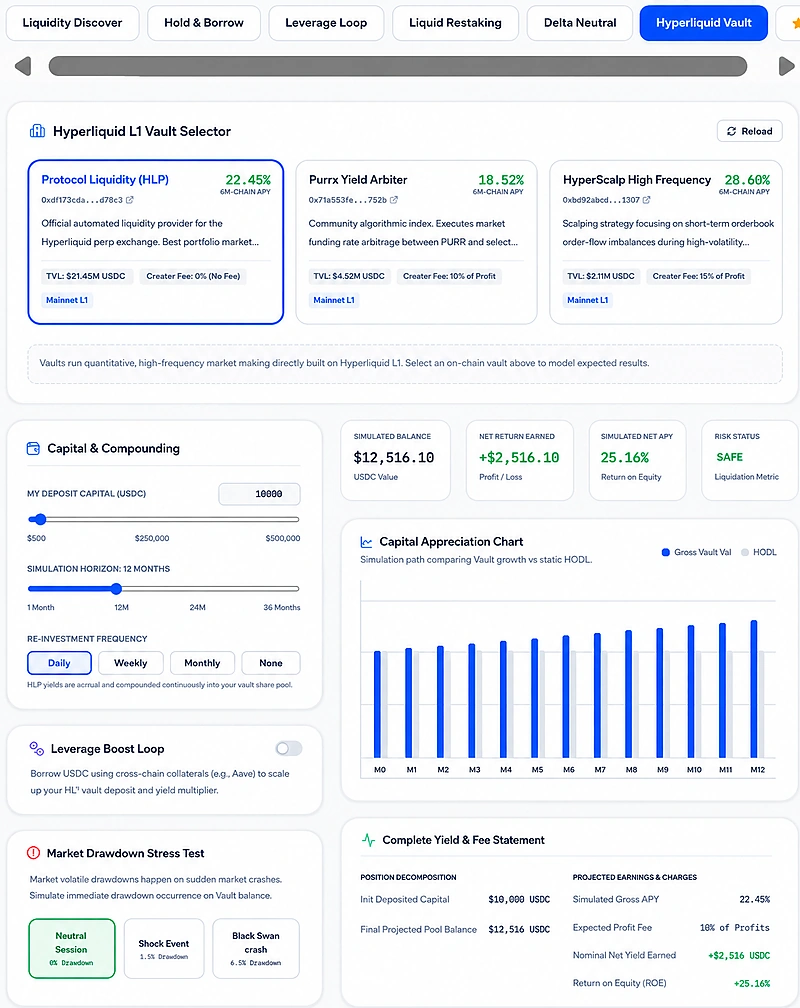
Vault exposure beyond the headline return
Hyperliquid vaults are strategy exposure, not simple deposit accounts. HLP-style vault exposure can depend on market-making conditions, trading volume, liquidation events, fee structure and drawdowns. Trader-led vaults add another layer: leader behavior, strategy drift and performance fees.
This simulator helps you compare return assumptions, leader or performance fee impact, compounding, holding period and drawdown scenarios before allocating capital to a Hyperliquid vault. It does not predict vault performance; it makes the assumptions easier to inspect.
For the deeper allocation checklist, read the Hyperliquid HLP vault risk and drawdown guide.
What this model helps you answer
Vault type
Compare HLP-style market-making exposure with user-managed or copy-trading vault assumptions where supported by available data.
Fee impact
See how performance fees or leader profit share can change the depositor-side result after a profitable period.
Volume scenarios
Test how lower or higher trading activity can affect modeled vault returns instead of assuming one static APY.
Drawdown risk
Model what the allocation looks like after an unfavorable trading period, slower growth or a larger drawdown than expected.
Questions to answer before using a vault
Is a Hyperliquid vault the same as passive yield?
No. Vault returns depend on trading performance, market conditions, fees, execution and drawdown. Treat the historical return as an input to test, not as a fixed future yield.
What should a Hyperliquid HLP simulator stress-test?
The useful tests are lower volume, weaker return, higher fee drag, larger drawdown, slower recovery and the effect of entering after a strong performance period.
Why compare vault risk with LP or hedge risk?
Many users choose between vault exposure, concentrated liquidity, a delta-neutral hedge or a simpler lending position. Comparing them helps avoid treating one attractive APY as the whole decision.
Explore adjacent risk workflows
DeFi strategies usually connect more than one risk surface. These pages help you move from one assumption set to the next without reducing the app to a single calculator.
Read the vault risk guide
Review HLP-style exposure, leader fees, volume assumptions and drawdown before allocating.
Read the Hyperliquid vault guide →Compare hedge mechanics
Vault risk and delta-neutral hedge risk are different; model both before treating them as substitutes.
Open the Delta Neutral Simulator →Review examples
Use the examples page to compare vault exposure with simpler LP, lending and hedge workflows.
Read DeFi simulation examples →Stop guessing. Start optimizing.
Make data-driven DeFi decisions based on structured mathematical modeling. Explore liquidity ranges, hedging paths, and pool risk scenarios.