Liquid Restaking Auto-Loop
Model LRT loop scenarios with restaking assets, borrow cost, leverage, depeg stress and liquidation risk.
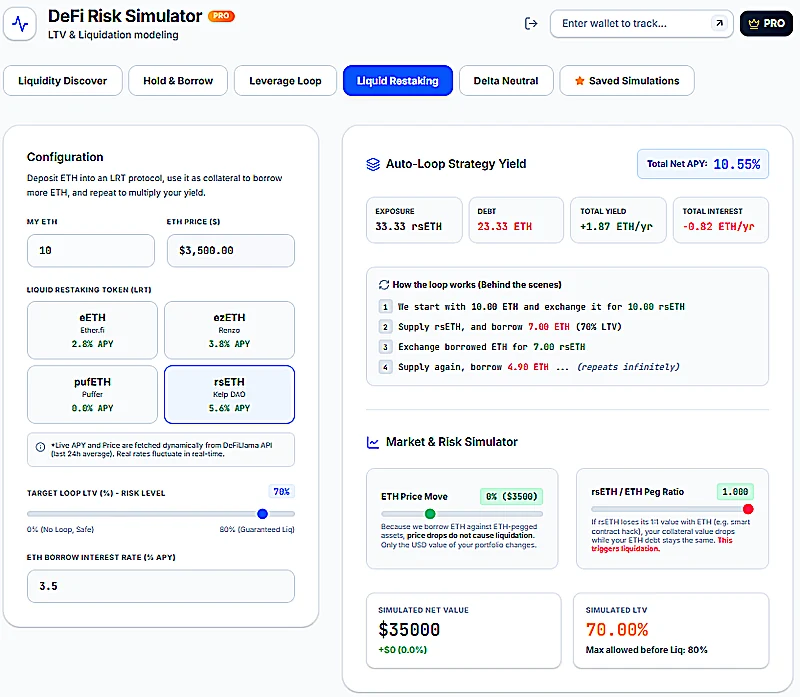
Restaking loops with depeg risk included
Liquid restaking strategies can look simple when only the yield is shown. This simulator adds the parts that usually matter when conditions change: leverage, borrow cost, collateral value, depeg scenarios, liquidation threshold and net position value.
Use it to compare assumptions around LRT collateral, ETH-correlated assets, borrowing cost and depeg stress before increasing exposure to a restaking loop.
For the risk logic behind recursive LRT positions, read the LRT loop risk and depeg stress guide.
What this model helps you answer
LRT exposure
How much exposure is created when the restaking asset is reused as collateral?
Borrow cost
How much of the expected return is reduced by the cost of keeping the loop open?
Depeg stress
What happens if the LRT trades below its expected ETH relationship during a stressed market?
Liquidation path
Where does the position become fragile when collateral value, debt and liquidation threshold are viewed together?
Explore adjacent risk workflows
DeFi strategies usually connect more than one risk surface. These pages help you move from one assumption set to the next without reducing the app to a single calculator.
Compare generic loop risk
Separate restaking-specific depeg stress from the basic debt mechanics of a leverage loop.
Open the Leverage Loop Simulator →Read the LRT risk article
Review the practical risks around eETH, ezETH-style collateral, depeg and LTV pressure.
Read the LRT loop risk guide →Check the risk disclaimer
Restaking returns, incentives and slashing assumptions can change after a simulation is built.
Read the risk disclaimer →Stop guessing. Start optimizing.
Make data-driven DeFi decisions based on structured mathematical modeling. Explore liquidity ranges, hedging paths, and pool risk scenarios.