Concentrated Liquidity Range Simulator
Model LP ranges, fee tiers, active liquidity, token exposure, impermanent loss and out-of-range risk across Uniswap V3/V4, PancakeSwap V3 and Aerodrome-style pools.
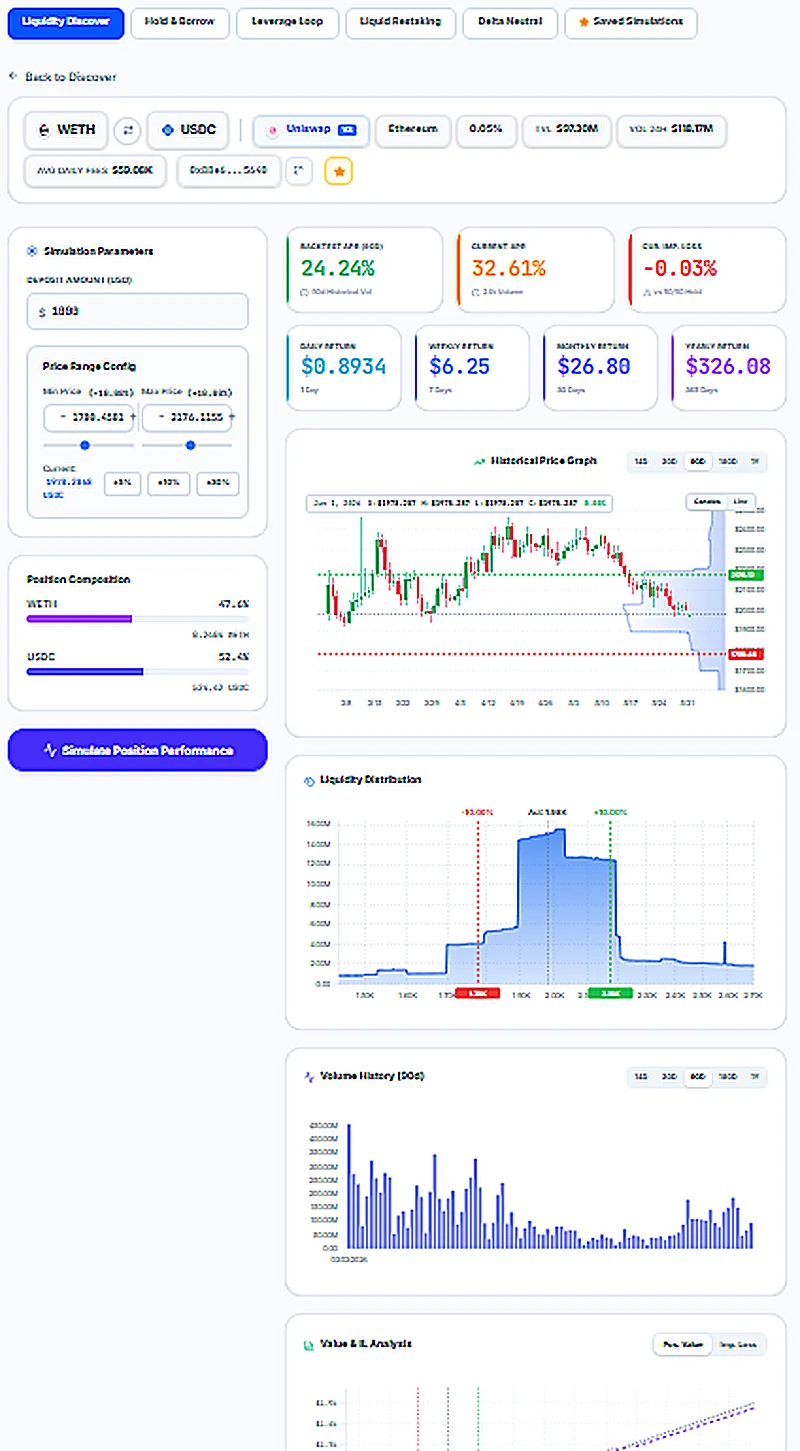
Test the range before you deposit
Concentrated liquidity gives LPs control over the price range where their capital is active. That control can improve fee efficiency, but it also makes range choice, token exposure and out-of-range risk much more important.
This simulator helps you compare how a position may behave if price stays inside the range, moves toward one side, or leaves the active range. It is broader than a single Uniswap V3 calculator: the model is designed around multi-DEX concentrated liquidity logic, including Uniswap V3/V4, PancakeSwap V3 and Aerodrome-style markets where supported data is available.
Use it when you need more than a static impermanent loss calculator. The useful question is whether a selected range can earn enough fees to justify impermanent loss, LVR, gas or rebalancing cost, and time spent out of range.
For the strategy logic behind range width, fee tier and impermanent loss assumptions, read the concentrated liquidity range and impermanent loss guide. For the formula itself, use the impermanent loss formula guide.
Range width
Compare tight, balanced and wide ranges against expected volatility and active time.
Fees vs IL
Check whether fee assumptions can compensate for impermanent loss and LVR-like drag.
Out-of-range risk
See how token exposure changes when price moves toward either edge of the range.
What this model helps you answer
Range fit
Is this range wide enough for the way the asset usually moves, or too narrow for the expected volatility?
Token exposure
How does the position shift between the two tokens as price moves toward either side of the range?
Fees vs risk
Can the fee assumption justify the range risk, impermanent loss and time spent out of range?
Hold comparison
How does the LP scenario compare with simply holding the two assets through the same price move?
Explore adjacent risk workflows
DeFi strategies usually connect more than one risk surface. These pages help you move from one assumption set to the next without reducing the app to a single calculator.
Start with live pool discovery
Find pools by TVL, volume, fee tier and simulator readiness before choosing a range.
Discover live liquidity pools →Read the impermanent loss guide
Use the LP risk article when you want the math behind fee-versus-loss trade-offs.
Read the impermanent loss guide →Test a hedge overlay
Compare LP exposure with futures or options hedge assumptions when directional risk matters.
Open the Delta Neutral Simulator →Stop guessing. Start optimizing.
Make data-driven DeFi decisions based on structured mathematical modeling. Explore liquidity ranges, hedging paths, and pool risk scenarios.