Leverage Loop
A recursive borrowing simulator. Model boosted exposure from leveraged strategies while keeping debt, borrow cost, and liquidation risk visible.
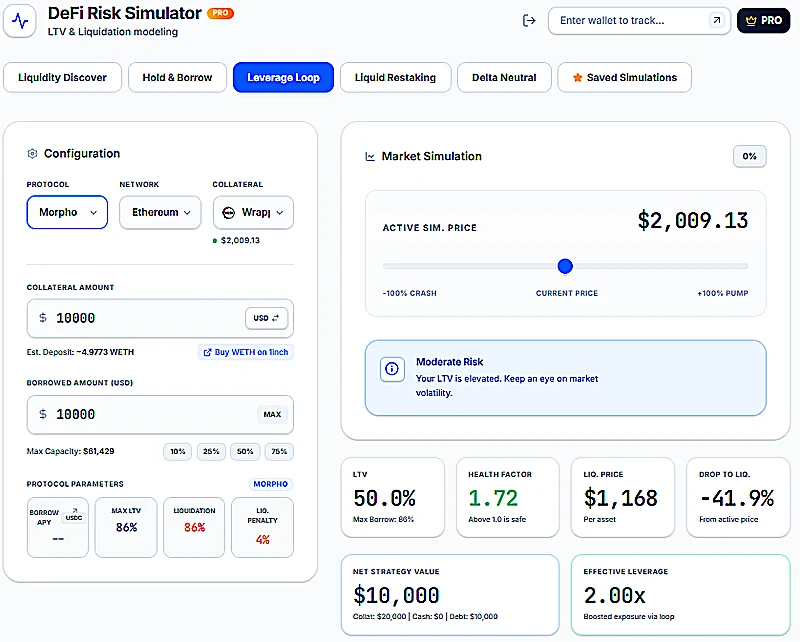
Recursive borrowing with the debt visible
Leverage Loop models a strategy where collateral is deposited, borrowed against, converted back into more collateral and deposited again. This can increase exposure, but it also increases debt and reduces the room for error.
The simulator keeps collateral value, borrowed value, health factor, liquidation threshold, borrow cost and net position value in the same view so you can test whether the loop still makes sense after a price move or rate change.
What this model helps you answer
Loop size
How much exposure is added by the recursive borrow-and-deposit structure?
Debt load
How much borrowed value remains open, and how sensitive is the position to variable borrow rates?
Liquidation distance
How much price movement can the position absorb before health factor becomes uncomfortable?
Net outcome
Does the scenario still look reasonable after borrow cost, collateral movement and liquidation risk are included?
Explore adjacent risk workflows
DeFi strategies usually connect more than one risk surface. These pages help you move from one assumption set to the next without reducing the app to a single calculator.
Model the base loan first
Start with simple collateral, debt, LTV and health factor before adding recursive exposure.
Open the Hold & Borrow Modeler →Stress LRT loop assumptions
If the loop uses liquid restaking collateral, include depeg and borrowing-cost scenarios.
Open the Liquid Restaking Simulator →See loop examples
Walk through how a loop can look attractive on APY but fragile after debt and liquidation risk.
Read leverage loop examples →Stop guessing. Start optimizing.
Make data-driven DeFi decisions based on structured mathematical modeling. Explore liquidity ranges, hedging paths, and pool risk scenarios.