Hold & Borrow Modeler
Model a DeFi borrowing position with collateral, debt, LTV, health factor, borrow cost, liquidation threshold and price-move scenarios.
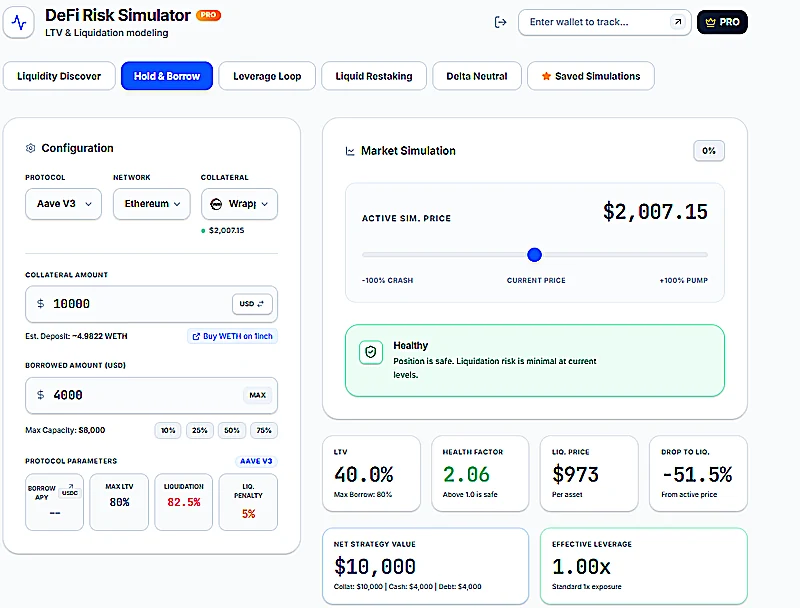
Model the loan before you open it
Hold & Borrow helps you model a borrowing position before taking on debt. Choose collateral, protocol assumptions, borrowed asset, loan size and a market move scenario, then review LTV, health factor, liquidation threshold, borrow cost, estimated liquidation price, cash on hand and net position value.
This page is not only a liquidation price calculator. Liquidation price is one output inside a broader borrowing model. The goal is to show how the whole loan behaves when collateral value changes, debt stays open, rates matter and risk moves closer or farther away.
For a deeper explanation of the metrics behind the model, read the LTV, health factor and DeFi borrowing risk guide.
What this model helps you answer
LTV
How much debt sits against the selected collateral value, and how quickly that ratio changes when price moves.
Health factor
A lending risk metric based on collateral value, debt and liquidation threshold. Near 1.0 leaves little room for price movement.
Liquidation price
The estimated collateral price where health factor reaches 1.0 under the selected assumptions. Real execution can also depend on protocol rules, oracle behavior and market conditions.
Borrow cost
The variable cost of keeping the loan open. A position can look comfortable at entry and become less attractive if rates move.
Explore adjacent risk workflows
DeFi strategies usually connect more than one risk surface. These pages help you move from one assumption set to the next without reducing the app to a single calculator.
Stress test recursive borrowing
If the position becomes a loop, model total debt, effective leverage and liquidation distance.
Open the Leverage Loop Simulator →Read the borrowing risk guide
Review how LTV, health factor, liquidation threshold and borrow cost work together.
Read the DeFi borrowing risk guide →Review methodology
See how DeFiRiskSim treats borrowing outputs as scenario estimates, not guarantees.
Read the simulation methodology →Stop guessing. Start optimizing.
Make data-driven DeFi decisions based on structured mathematical modeling. Explore liquidity ranges, hedging paths, and pool risk scenarios.