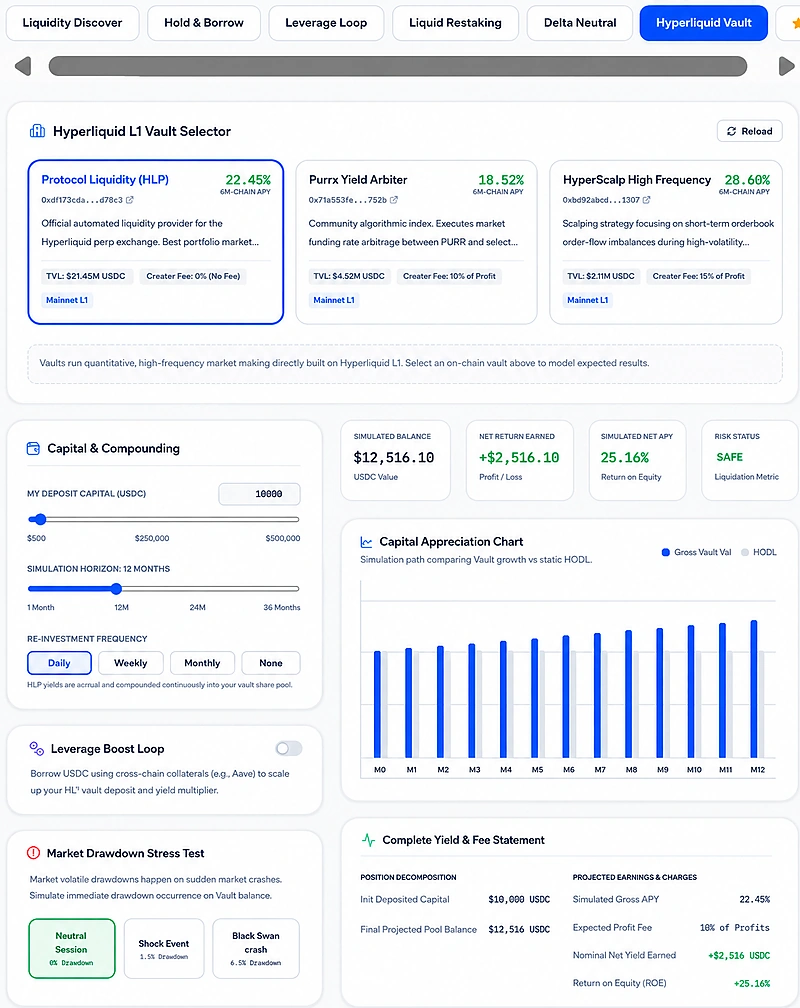
What Hyperliquid Vaults Are Trying to Do
Hyperliquid is a trading-focused L1 with perpetual futures, order book infrastructure and vault strategies. Vaults can give users exposure to automated market-making behavior, trading strategies or leader-managed pools. The attraction is clear: users want exposure to an active trading venue without manually running every trade.
But vault exposure is still strategy exposure. Returns depend on trading conditions, liquidity, market volatility, volume, execution and risk management. The DeFiRiskSim Hyperliquid Vault Simulator models those assumptions directly instead of treating vault APY as guaranteed yield.
HLP, Volume and Market-Making Assumptions
Market-making style vaults generally depend on trading activity. Higher volume can create more opportunities, but it can also come with sharp volatility and adverse selection. Lower volume may reduce opportunities and change expected returns.
A vault simulator should let users test different volume assumptions. A single historical APY is not enough, because the future trading environment may not look like the past window used to calculate it.
| Vault exposure | What users usually like | What should be stress-tested |
|---|---|---|
| HLP-style market making | Exposure to exchange activity without manually quoting markets. | Lower volume, adverse selection, liquidation events, inventory swings and deeper drawdowns. |
| Trader or leader vault | Access to a managed strategy with a visible track record. | Position concentration, strategy drift, leader fees, leverage use and sudden loss periods. |
| Custom vault allocation | A way to size exposure around personal return and risk targets. | Capacity, withdrawal timing, correlated market stress and the opportunity cost of capital. |
Leader Fees and Copy-Trading Vaults
Some vaults include leader or performance fees. These fees matter because gross strategy performance is not the same as depositor performance. A strategy can look attractive before fees but much less attractive after fees and drawdowns.
DeFiRiskSim exposes these assumptions so users can compare the vault's headline return with the net scenario they might actually experience.
Gross Return Is Not Depositor Return
A common mistake is to compare vaults by headline APY alone. Depositor return depends on the starting capital, gross strategy performance, leader or performance fee, compounding period, drawdown path and the timing of entry and exit. A user who enters after a strong run can still face a bad outcome if the next period is flat or negative.
A practical model should separate gross vault performance from net user outcome. In DeFiRiskSim, that means testing fees, holding period, return assumptions and drawdown together. The useful question is not "What did this vault earn before?" It is "What happens to my allocation if the next regime is worse than the last one?"
Drawdown Is the Number Users Should Respect
Drawdown is the peak-to-trough loss a vault experiences over a period. It is often more useful than APY for understanding risk. A vault with high return and deep drawdowns may be unsuitable for users who cannot tolerate volatility.
A good simulator should allow users to ask: What happens if returns are lower than expected? What happens if drawdown is larger? What happens if deposits grow but performance weakens? These questions are especially important for rapidly growing vaults.
When a Vault Looks Good but Risk Is Rising
A vault can look attractive while its risk is increasing. Warning signs include fast deposit growth without the same growth in opportunity, returns that rely on one volatile market regime, a small number of large positions, unclear fee impact, or a drawdown that would force the user to exit at the worst time.
This is why vault analysis should include a bad-case scenario before the deposit. Model lower return, higher fee drag, slower recovery and a larger drawdown than the dashboard suggests. If the allocation only makes sense in the optimistic case, it is not a resilient vault allocation.
A Practical Vault Evaluation Workflow
- Start with the vault type: HLP-style, copy-trading or custom strategy.
- Enter capital and realistic return assumptions.
- Model lower-volume and higher-volatility cases.
- Include leader or performance fees.
- Check whether withdrawal timing could matter during stress.
- Stress drawdown and recovery time.
- Compare the vault with simpler alternatives.
- Allocate only if the bad case is still acceptable.
If the vault is part of a broader portfolio, compare it with the Delta Neutral Strategy Simulator and the Concentrated Liquidity Simulator. Many users are not choosing a vault in isolation; they are choosing between vault exposure, LP exposure, hedged exposure and simple cash-like alternatives.
FAQ
Are Hyperliquid vault returns guaranteed?
No. Vault performance depends on trading results, market conditions, fees and risk controls. Past APY does not guarantee future return.
Why simulate drawdown?
Drawdown shows how painful a strategy can become during bad periods. It helps users judge whether the risk is acceptable, not only whether the return looks attractive.
What should I compare before entering a vault?
Compare gross return, net return after fees, volume assumptions, drawdown, vault growth, strategy transparency and your own liquidity needs.
Works Cited
- Hyperliquid Documentation, https://hyperliquid.gitbook.io/hyperliquid-docs
- Hyperliquid App, Vaults, https://app.hyperliquid.xyz/vaults