What a DeFi Liquidation Calculator Should Actually Show
A useful liquidation calculator is not just a simple loan-to-value widget. It should show the relationship between collateral, debt and liquidation rules in a way that a borrower can use before opening a position.
In lending protocols such as Aave, Compound, Morpho, Spark and Maker/Sky, users deposit collateral and borrow against it. The position remains healthy while the collateral value is high enough relative to the debt. If the collateral falls, the debt grows, or the protocol changes risk parameters, the position can move toward liquidation.
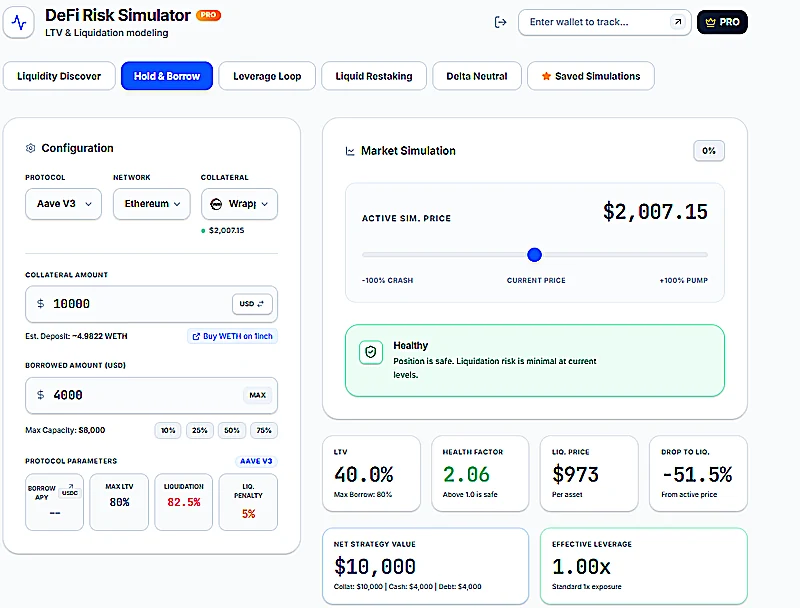
The DeFiRiskSim Hold & Borrow Modeler is built for this workflow. It helps users compare collateral value, borrowed amount, LTV, health factor, liquidation price, borrow APY and drawdown buffers before they put real capital at risk.
LTV, Liquidation Threshold and Health Factor
Loan-to-value, or LTV, compares borrowed value with collateral value. If a user deposits $10,000 of ETH and borrows $4,000 of USDC, the position has a 40% LTV before interest and price movement.
Liquidation threshold is different. It is the protocol's risk boundary for a collateral asset. A volatile asset usually has a lower threshold than a stable or highly liquid asset. Health factor is the safety score derived from collateral value, liquidation threshold and debt. A health factor above 1 means the position has a buffer. A health factor below 1 means it can be liquidated.
This is why two borrowers with the same LTV can have different risk. The collateral asset, liquidation threshold, oracle behavior and borrow growth all matter.
The Short Answer: LTV Is Position Size, Health Factor Is Liquidation Risk
People often search for LTV calculators and health factor calculators as if they are the same tool. They are related, but they answer different questions.
| Metric | What it answers | Why it matters |
|---|---|---|
| LTV | How much debt is open relative to collateral value? | Useful for position sizing and comparing debt load. |
| Liquidation threshold | At what collateralization boundary can the protocol liquidate? | Different assets can have different liquidation boundaries. |
| Health factor | How close is the position to the liquidation boundary? | Better than LTV alone for daily risk monitoring. |
| Liquidation price | What collateral price would push health factor toward 1? | Makes the risk easier to compare with market volatility. |
How Liquidation Price Is Estimated
Liquidation price estimates the market price where health factor reaches the liquidation boundary. For single-collateral borrowing, the intuition is simple: as collateral price falls, collateral value falls. Debt remains the same or grows with interest. At some point the position no longer has enough collateral margin.
A calculator should not hide that estimate behind a black box. It should show the borrow amount, collateral price, liquidation threshold and resulting buffer. DeFiRiskSim focuses on these visible assumptions so users can test different collateral prices instead of relying on one optimistic scenario.
How Much Health Factor Buffer Is Enough?
There is no universal safe health factor. A stablecoin loop, an ETH-backed loan, a long-tail collateral market and an LRT borrowing position all need different buffers. The right question is not "what number is safe?" but "what bad case can this position survive?"
A practical model should test at least three cases: a normal market move, a bad week and a severe stress event. For volatile collateral, a borrower should also ask whether the position survives a fast wick, a temporary oracle lag, a utilization spike in borrow rates or a correlated sell-off across DeFi collateral.
Base case
Current collateral price, current borrow cost and normal volatility.
Bad case
A meaningful collateral drawdown plus higher borrow APY.
Severe case
A sharp price move, thin liquidity, depeg risk or correlated collateral stress.
Borrow APY Can Move the Liquidation Boundary
Many borrowers focus only on collateral price, but borrow cost matters too. If borrow APY rises, debt grows faster. Over time, the position can become less safe even if the collateral price does not crash immediately.
This is especially important in recursive strategies. A leverage loop increases both collateral and debt. When the yield spread is positive, looping may look attractive. When borrow APY rises, the same position can quickly become fragile. The Leverage Loop Simulator extends the same liquidation logic into recursive borrowing scenarios.
Aave-Style Health Factor vs Morpho-Style LLTV
Different lending systems expose risk in different language. Aave-style interfaces commonly emphasize health factor across a user account. Morpho-style isolated markets often emphasize LLTV, the liquidation loan-to-value for a specific collateral and loan market. The user question is the same: how much collateral value can disappear before liquidation becomes possible?
That distinction matters when modeling risk. Account-based systems can combine several collateral and debt assets, while isolated markets make the risk easier to reason about but less forgiving if the selected market becomes stressed. DeFiRiskSim keeps the assumptions visible so the user can compare the model instead of treating every lending market as interchangeable.
A Practical Borrowing Workflow
- Choose the collateral asset and lending protocol model.
- Enter collateral value and borrowed amount.
- Check current LTV and health factor.
- Lower the collateral price until the model approaches liquidation.
- Increase borrow APY to test debt growth.
- Compare the liquidation price with historical volatility and your own risk tolerance.
- Keep a larger buffer than the minimum number the protocol allows.
Common Mistakes Borrowers Make
- Borrowing to the limit: A position can look efficient but leave no room for volatility.
- Ignoring borrow rate changes: Variable borrow rates can change when utilization rises.
- Assuming stablecoins are risk-free: Stablecoin depegs and oracle behavior still matter.
- Ignoring correlation: Collateral and borrowed assets can move in unexpected ways during stress.
- Using one price scenario: A serious model needs normal, bad and severe cases.
When a Liquidation Price Calculator Is Not Enough
A single liquidation price can create false comfort. It does not show how fast debt grows, how liquidators behave, how oracle updates work, how close the market can trade during a wick, or whether the borrower can add collateral in time. It also does not explain whether the position still makes economic sense after borrow cost.
This is why DeFiRiskSim treats liquidation price as one output inside a broader DeFi risk simulator. The better workflow is to model the loan, stress the market path, compare the downside with the intended yield, then decide whether the remaining buffer is worth the risk.
FAQ
What is liquidation price in DeFi?
It is the estimated collateral price where the borrowing position reaches the protocol's liquidation boundary. The exact mechanics depend on protocol parameters, collateral type and oracle behavior.
Is health factor better than LTV?
Health factor is usually more useful for liquidation risk because it includes liquidation threshold. LTV is still helpful, but it is not the whole risk score.
What health factor should I keep?
There is no fixed number that fits every market. A borrower should test the collateral's volatility, borrow APY, liquidity, protocol rules and the size of a severe price move before choosing a buffer.
Why can two loans with the same LTV have different liquidation risk?
Because liquidation threshold, collateral volatility, oracle design, market liquidity and debt growth can differ. LTV is only one input.
Can a simulator prevent liquidation?
No. A simulator can show risk scenarios and help users choose larger buffers, but it cannot control markets, oracles, protocol rules or future prices.
Works Cited
- Aave Help Center, Liquidations, https://aave.com/help/borrowing/liquidations
- Aave Docs, Risk Parameters and Health Factor, https://aave.com/docs
- Morpho Documentation, Markets and Collateral, https://docs.morpho.org/