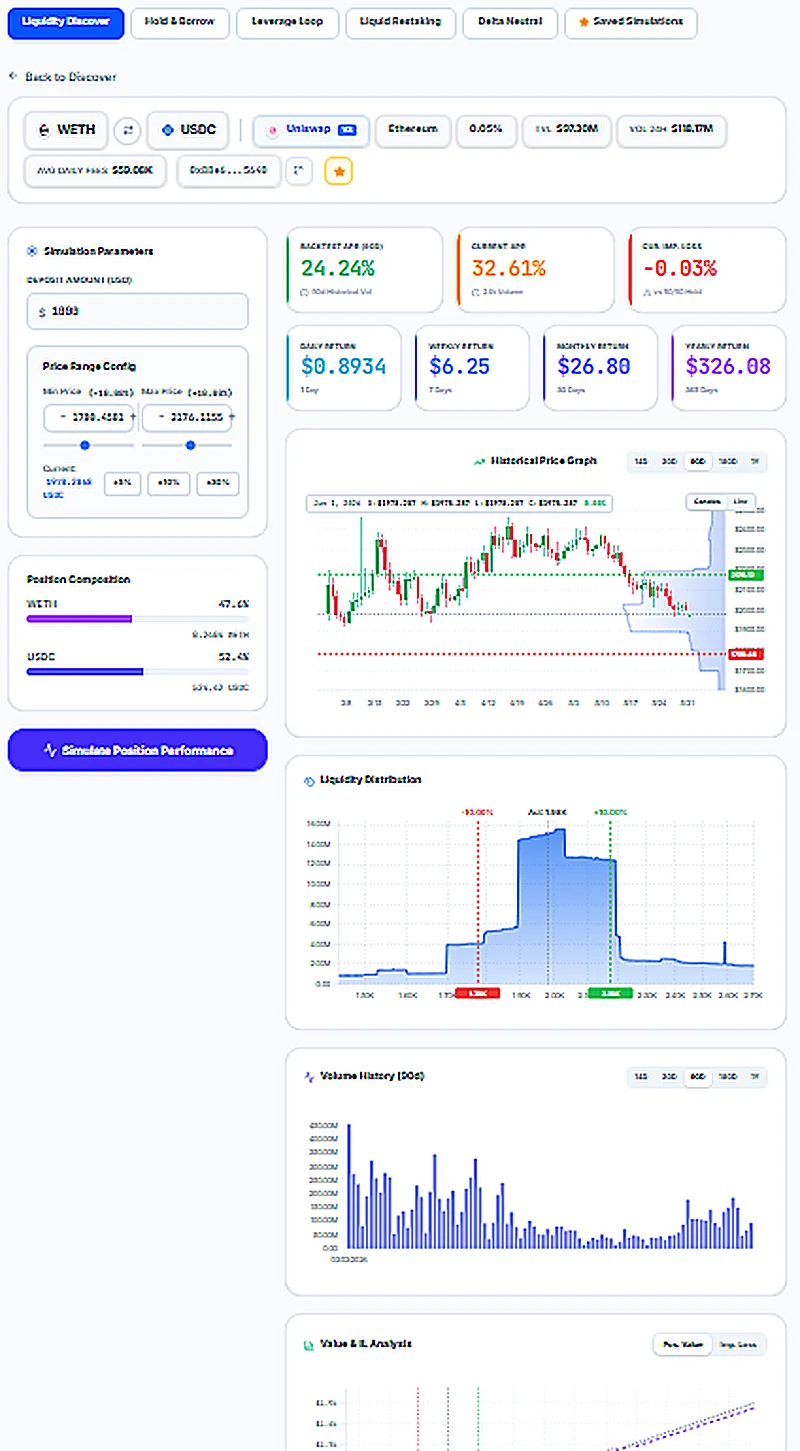
Quick Answer: How Should You Choose an LP Range?
Start with expected volatility and fee tier, then test tight, medium and wide ranges against the same price move. A narrow range can earn more fees while active, but it also reaches one-sided exposure faster and may spend more time out of range.
The range is only attractive if plausible fees beat impermanent loss, LVR-like drag, gas or rebalancing cost, and the risk of holding the weaker token after a directional move.
Why Concentrated Liquidity Is Different
In a classic constant-product AMM, liquidity is spread across the entire price curve. In concentrated liquidity, LPs choose a specific price range. Capital is active only while price stays inside that range. This makes capital more efficient, but it also makes range selection the central risk decision.
Uniswap V3 popularized this model, and similar mechanics now appear across PancakeSwap V3, Aerodrome Slipstream and other DEX designs. The DeFiRiskSim Concentrated Liquidity Simulator is built to help users evaluate these range-based positions before depositing.
Narrow Range vs Wide Range
A narrow range concentrates more capital near the current price. If the market remains inside the band, the position can capture a larger share of fees for the same capital. The trade-off is fragility. A small move can push the position out of range, stop fee earning and leave the LP mostly in one asset.
A wider range is usually less capital efficient, but it can survive more price movement. There is no universally best range. The right range depends on expected volatility, fee tier, pool volume, rebalancing cost, token correlation and the LP's risk tolerance.
Fee Tier Is a Risk Signal
Fee tier is not just a revenue input. It also signals the type of market. Stable pairs often use lower fees because volatility is lower and volume can be high. Volatile pairs often need higher fees because LPs take more price risk and impermanent loss risk.
When comparing pools in Liquidity Discover, users should compare fee tier with daily volume, TVL, volatility and pool depth. A high fee tier does not automatically mean a better strategy. It may simply compensate LPs for larger losses or thinner liquidity.
Impermanent Loss Is Not Optional
Impermanent loss is the difference between holding tokens and providing them to an AMM after price changes. In concentrated liquidity, the effect can be more intense because capital is deployed inside a narrower range. The position's token composition changes as price moves through the range.
This is why a useful LP simulator must show more than estimated fees. It should show downside scenarios, token allocation, out-of-range behavior and the fee-versus-loss trade-off. A position that looks attractive at today's price may become poor if the market trends in one direction.
When an Impermanent Loss Calculator Is Not Enough
Many LPs start with an impermanent loss calculator, but a single IL number does not answer the full concentrated liquidity question. It does not show how much time the position may spend out of range, how fees change with volume, how token exposure shifts near the range edge, or whether rebalancing costs erase the fee advantage.
A concentrated liquidity simulator should connect those pieces. The useful output is not only "expected IL"; it is whether the chosen range still makes sense after fees, price path, volatility, active liquidity time and out-of-range behavior are modeled together.
| Question | Simple calculator | Scenario simulator |
|---|---|---|
| How large is IL? | Usually yes. | Yes, with fee and price-path context. |
| Will the range stay active? | Usually no. | Models inside-range and out-of-range cases. |
| What token will I hold after a move? | Often hidden. | Shows token exposure as price moves. |
| Are fees worth the risk? | Hard to answer. | Compares fees, IL, range width and downside. |
A Practical Range Selection Checklist
- Start with the pool's current price and recent volatility.
- Compare fee tier with the pair's expected price movement.
- Choose a narrow, medium and wide range scenario.
- Estimate fees under realistic volume assumptions.
- Estimate impermanent loss under down, flat and up scenarios.
- Check when the position becomes fully one-sided.
- Decide whether rebalancing cost and effort are acceptable.
When a Hedge May Help
Some LPs use derivatives to reduce directional exposure. A futures short can offset part of the volatile asset exposure, and a put option can provide downside protection. But hedging is not free. It introduces funding, margin, liquidation, option premium, spread and execution risk.
That is why DeFiRiskSim includes hedge modeling alongside LP simulation. The goal is not to label a hedge as good or bad. The goal is to show how much protection remains after cost and where the hedge can fail.
For hands-on modeling, start with the Concentrated Liquidity Simulator, then compare hedge assumptions in the Delta Neutral Strategy Simulator.
FAQ
What is the best concentrated liquidity range?
There is no universal best range. Narrow ranges can earn more fees while active, but wider ranges can survive more price movement. The best choice depends on volatility, fee tier, volume and rebalancing plan.
Why does a position stop earning fees?
In concentrated liquidity, the position earns fees only while the market price is inside the selected range. If price leaves the range, liquidity becomes inactive until price returns or the LP rebalances.
Can fees always offset impermanent loss?
No. Fees can offset losses in some scenarios, but strong directional moves, low volume or poor range selection can leave LPs worse off than holding.
Works Cited
- Uniswap Docs, Concentrated Liquidity, https://docs.uniswap.org/concepts/protocol/concentrated-liquidity
- Uniswap V3 Core, Pool State Interface, https://github.com/Uniswap/v3-core
- Risks and Returns of Uniswap V3 Liquidity Providers, arXiv, https://arxiv.org/abs/2205.08904